



If you want a trip that doesn’t feel like everyone else’s Instagram feed, put Meghalaya on the list for 2026. Tucked into India’s northeast, it’s a state built from mist, limestone, and rivers so clear they look photoshopped plus the living root bridges that people travel across the world just to walk over.
This isn’t a place for checklist tourism. You’ll spend hours climbing down stone steps to a waterfall, or just sitting by a river doing nothing in particular, and it’ll still feel like the best part of the trip. Here’s the best Meghalaya itinerary where to go and why each stop earns its place on the map.
1. Shillong — Where the Trip Usually Starts
Most people fly into Shillong first, and it’s a fair introduction to the state. Locals half-jokingly call it the “Scotland of the East,” and once you’re driving past pine ridges with a chill in the air, you’ll get why.
It’s also a genuinely lived-in city, cafes with live music, a market that never quite stops moving, and hills on every horizon.
Worth your time: Umiam Lake, Ward’s Lake, Shillong Peak, Elephant Falls, and Police Bazaar for an evening walk.
Shillong has one of India’s strongest local music scenes, so if there’s a gig happening while you’re there, go.
Best time to visit: October to April

2. Cherrapunji (Sohra) — Waterfall Country
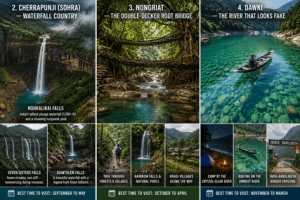
Cherrapunji, or Sohra as locals call it, holds records for some of the highest rainfall anywhere on Earth. That rain is exactly why the place looks the way it does, cliffs dropping into green, waterfalls everywhere you look, clouds that roll through at eye level.
Even in the dry months it doesn’t disappoint.
Nohkalikai Falls is the headline act at over 1,100 feet, it’s India’s tallest plunge waterfall, and the turquoise pool at the bottom is one of the most photographed spots in the northeast.
Seven Sisters Falls puts on its real show during monsoon, when seven separate streams pour off the same cliff at once.
Dainthlen Falls is smaller but comes with a story, it’s tied to local Khasi folklore, so it’s worth asking a guide about the legend while you’re there.
Best time to visit: September to May
Explore: 10 Best Places for trip in North East India
3. Nongriat — The Double-Decker Root Bridge
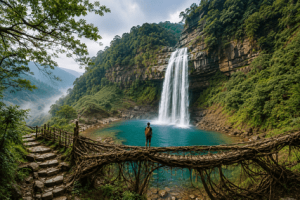
If Meghalaya has one signature attraction, it’s this. In Nongriat village, rubber tree roots have been trained across a river over generations, growing into a living bridge that can hold hundreds of people at once. There’s nothing quite like it anywhere else.
Getting there means several thousand stone steps down through forest and small villages, it’s a proper trek, not a stroll, but almost everyone who’s done it says it was the highlight of their trip.
Once you’re down there: the Double-Decker bridge itself, Rainbow Falls, a few natural swimming pools to cool off in, and the Khasi villages along the way.
Best time to visit: October to April
4. Dawki — The River That Looks Fake
Dawki has become something of a social media legend, and for once the photos undersell it. Near the India-Bangladesh border, the Umngot River runs so clear in winter that boats seem to hover over nothing.
Go boating, camp on the riverbank, bring a camera, and if you’re curious, take a look at the border crossing nearby. Time it for the drier months when the water’s at its clearest that’s when the illusion really lands.
Best time to visit: November to March
5. Mawlynnong — Asia’s Cleanest Village
Mawlynnong has picked up a reputation as one of the cleanest villages in Asia, and it’s earned it through genuine community effort, not marketing. It’s a good place to slow down, walk through bamboo groves, chat with locals, and see what community-run tourism actually looks like when it’s done right.
Don’t skip the Bamboo Sky Walk, the Balancing Rock nearby, and the smaller root bridges just outside the village.
Best time to visit: year-round
6. Mawsmai Cave — An Easy Way Underground
Meghalaya has some of Asia’s longest cave systems, and Mawsmai is the most accessible entry point if you’ve never done any caving before. Expect narrow passages, striking limestone formations, and enough natural light filtering in that it never feels claustrophobic.
It’s close to Cherrapunji, beginner-friendly, and a good taste of the state’s much bigger underground world.
Best time to visit: October to April
7. Laitlum Canyon — The View Everyone Misses
Laitlum still flies under the radar compared to the rest of the state, which is part of its appeal. The name means roughly “end of hills,” and standing at the edge on a clear day, you’ll see exactly why valleys, footpaths, and tiny villages laid out below like a map.
Go for sunrise if you can manage the early start, or just wander the trails and let the views do the talking.
Best time to visit: October to March

8. Krang Suri Falls — The Blue Pool
Tucked into the Jaintia Hills, Krang Suri has a color that doesn’t look real until you’re standing in front of it: a deep, almost electric blue pool at the base of the falls. You can swim in it, which not every waterfall in Meghalaya allows, or just sit on the rocks and take it in.
It’s becoming more popular with photographers, but it hasn’t lost its calm.
Best time to visit: October to April
9. Mawphlang Sacred Forest
For something less about scenery and more about meaning, visit Mawphlang. The Khasi community has protected this forest for centuries, and it shows old-growth trees, medicinal plants, and sacred sites still tied to local belief.
Go with a local guide if you can; the stories behind the forest matter as much as the trees themselves.
Best time to visit: October to April
Why Meghalaya Is Worth the Trip
What sets Meghalaya apart isn’t any single waterfall or bridge, it’s that the place hasn’t been flattened into a tourist product. Communities here have kept their traditions and their land largely intact even as more visitors show up each year, and you can feel that difference the moment you arrive.
Discover: Top 9 Adventure Sports in Meghalaya
Final Thoughts
Between the waterfalls of Cherrapunji, the root bridges of Nongriat, the glass-clear water at Dawki, and caves running underneath half the state, Meghalaya packs in more variety than its size suggests. Give it 7 to 10 days if you have enough time to actually slow down, rather than sprint between the famous spots. Some of the best moments come from the parts that don’t make it into any list: a random conversation on a village walk, a viewpoint you stumbled on by accident, a road that took longer than planned but was worth every extra minute.
At The Tarzan Way, we plan trips around exactly that mix the landmarks worth seeing, and the local moments worth remembering.
FAQs
1. How many days do you need in Meghalaya?
Seven to ten days is a comfortable pace for Shillong, Cherrapunji, Dawki, Mawlynnong, Nongriat, and the smaller stops in between.
2. What’s the best time to visit?
October through April, generally the weather’s pleasant and the views are clearest.
3. Is it safe for solo travelers?
Yes. Meghalaya is one of the more relaxed, low-hassle destinations in India, and solo travelers visit it often.
4. What is Meghalaya known for?
Living root bridges, waterfalls, caves, its cleanest-village reputation, and landscapes that don’t look like the rest of India.
5. Which is better: Shillong or Cherrapunji?
Different trips, really. Shillong gives you culture and city energy; Cherrapunji gives you nature, waterfalls, and a bit of adventure. Most itineraries end up doing both.