

Change the way you travel!
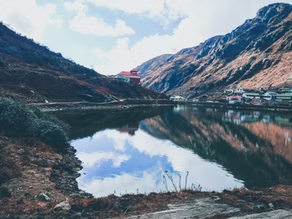
The lockdown and the coronavirus crisis are definitely taking a toll on people’s lives and being locked up in our houses for more than a month now can be certainly frustrating. Amidst this, the only thing which is keeping us safe from this virus is Social Distancing, which can be perfectly followed while traveling by road. Hitting the open road is a fine experience in itself. You not only get the freedom to stop at any scenic location of your choice but also get to explore its uniqueness holistically, and all of us deserve a perfect travel experience after we have overcome this. So here we have compiled a list of those ideal travel destinations in India which are least affected by the virus and should be on your bucket list once normalcy has been restored. Mapping state-wise coronavirus cases in India 1. Kinnaur, Himachal Pradesh Kinnaur: Land of Fairytales While Himachal in itself is stunningly beautiful, Kinnaur valley is a whole other world. Majestic mountains, green valleys, meandering rivers, apple orchards, vineyards, and smiling faces are synonymous with this region. It is a tiny hamlet in India where beauty resides and that is why it is acknowledged as the “Land of fairy tales.” The valleys of Kinnaur are also one of the most sought after camping destinations in India. Camping on the river Baspa and Satluj are some of the scenic destinations to pitch your tents for an overwhelming camping experience. One of the best ways to discover Kinnaur is to walk on the hilly terrains, sleep under the stars, admire the natural beauty, and exchange smiles with locals in far-off villages. Journey to Kinnaur via roadways can be worth-remembering experience as there are several places that will cast a spell over the visitors and want them to visit it again. Read more about the culture and tradition of Kinnaur in MagikIndia‘s Blogs 2. Sangti Valley, Arunachal Pradesh Sangti Valley A visit to Arunachal Pradesh is a journey into diverse cultures, delicious local cuisine, and mesmerizing valleys that will surely take your breath away. Surrounded by the towering ranges of Eastern Himalayas, blessed with pleasant weather round the year with light showers of snowfall, orchards laden with apples, kiwis and oranges, dotted with pristine forests and meandering fast hill rivers, Sangti Valley is the epitome of beauty and home to a very interesting culture and tradition. A road trip to Sangti Valley is an indescribable experience as you go through the long-isolated roads with long pine trees, exotic birds that act as beautiful garland hanging on the mountains ranges, and long meadows with horses, sheep, cows grazing on it. Shoestringsonthemove very well portrays the beauty of this hidden gem of India. 3. Jim Corbett, Uttarakhand Jim Corbett National Park Corbett’s wilderness is intriguing – leopards and tigers call it home, birds live in peace, locals enjoy the greenery, and tourists find the nature therapeutic. It is thrilling, scenic, and spectacular. Located on the banks of Ramganga and surrounded by hills, the dense forest of Jim Corbett is home to the majestic flora and wildlife, exciting every avid traveler. Beautified with an alluring landscape including rivers, forests, and hills outside the park, Corbett is more than just a national park. It is also a hub of adventurous activities like river rafting, rock climbing, rappelling, fishing, angling and more. It is a jungle retreat that offers a perfect remedy for a weekend of relaxation and natural delight. Check out Walking_wanderer‘s blog to know what things can be done when in Corbett 4. Zuluk, Sikkim Zuluk The gate of North-eastern India opens with the mesmerizing experience of Sikkim. If you need a break from your daily fast-pace life and want to explore yourself in the middle of rugged snowy mountains, then Sikkim is a perfect destination. Pleasant climate, organic vegetation, snow-covered landscape, and decent commercialization have endeared Zuluk in Sikkim as one of the best destinations for a serene retreat. While the landscape of Zuluk offers a host of adventure activities, the calm yet vibrant city life presents you with a bouquet of other experiences as well. From paragliding, river rafting, cable car rides, challenging treks, shopping, sightseeing, to birdwatching, there is no dearth of activities in the breathtaking realms of Zuluk for all kinds of travelers. A road trip to Zuluk is an amazing experience as one enjoys the scenic beauty of River Teesta on one side and soaring peaks parked along the other side of the road. Refer Travel.with.krish to know about his travel experience in Zuluk 5. Palolem Beach, Goa Palolem Beach, South Goa A kaleidoscopic blend of Indian and Portuguese cultures, sweetened with sun, sea, sand, seafood, susegad, and spirituality, Goa is India’s pocket-sized paradise. Goa’s biggest draw is undoubtedly its uninterrupted string of golden-sand beaches. It caters to every tropical whim: choose from backpacker Arambol or bolder, brasher Baga; the palm-fringed sands of Palolem, hippie market bliss at Anjuna or lovely laid-back Mandrem. Palolem normally more associated with heritage, colorful markets, and silent parties where partygoers wear headphones, it is lined with palm trees and colorful shacks which is also home to a huge variety of flora and fauna. Goa can be full of surprise for nature lovers and adventure enthusiasts. The lakes and rivers form the life of Goa and offers a rich biodiversity and scenic beauty that can be enjoyed through backwater cruises, kayaking or simply canoeing through the waterways. A road trip to Goa is an amazing trip that will make you fall in love with the town as you get to travel through the highway, small villages which is a whimsical existing wonder, and that makes it ever-so captivating. Ellis.veen has very well listed out things to do in her goa travel guide. 6. Spiti Valley, Himachal Pradesh The Middle Land of India:
House Arrest!?

Dear Diary #1 As you already know that the past couple of weeks have been completely overwhelming for me. I have been doing back to back shifts in my office, and I hardly have any time for myself. I know, I know that this is good for my future, but god! at what cost? XD So today I didn’t go anywhere, I was at my home, on my couch, and just relaxed and took a step back. I did not think about work because God knows I’ve done my fair share. I think today was the first time I was living in the moment, enjoying all the little things. LOL, #DeepTalks 😀 OMG! I completely forgot I watched Before Trilogy today. The movie was so good. Though it had no story it made perfect sense. I don’t know what was good, the acting or the dialogues!!! Sorry, got too excited 😛 PS. I think I am not going to go tomorrow as well, today was fun 😛 By: chatelaine.com Dear Diary #2 Hi! So today, I got up late. I was still tired because I didn’t sleep early yesterday because of the movie. Also, I had the ingenious idea to start cooking, so as you very well know, I opened up Gordan Ramsay’s video of ‘How to make a Scrambled Eggs’ on YouTube, and man! That brit knows how to cook :O I think my eggs were good but it was too salty XP Nevertheless, not bad for my first try. After breakfast, I continued with my tv show, Peaky Blinders. Dude! You have to see that show. It’s about this gang which uses blades and all. The show is based around their criminal empire between the two wars. I know!! Unmissable. For lunch, I just ordered in, nothing too great. Dinner too, I ordered in from Dominoes, and before you judge I think Dominoes is better than Pizza Hut. #ISaidIt Being at home for the second day was not that bad. 😛 By: in.pinterest.com Dear Diary #3 Hiiii! If you think I am excited, you should have seen me this morning. I was playing Call of Duty!!!! That too online with my friends. I had the highest number of kills brooo XD. My friend, disconnected after I killed his player 6 times back to back, straight. Also, I saw Downfall. The most brilliant film ever made in the entire freaking cinematic universe! It is about the last ten days of Hitler in his bunker. Damnnn, his acting was so gooood. I don’t think much else peculiar happened today. Dear Diary #4 Hey dude. If you think today was a good day then guess again, because you could not be more wrong. Today my boss called me. I was only half awake when he asked me where I was for the past few days. I wanted to lie to him, but noooo, I had to tell him that I was taking some ‘ME’ time. I could hear the silent judgment emanating. It was awkward. After this terrible ordeal, I went back to sleep. When I woke up, I saw that I have received a mail from HR. I have been called to the freaking HR because I just wanted some time to hold myself together. Damn those capitalists. #ISayThisAsIDrinkCoke TTYL. In no mood to write anything else. Dear Diary #5 Hii! I wanted to tell you I won. I wrote an elaborate e-mail to the HR, explaining my circumstances and they agreed and sanctioned a 14 days sabbatical. I was in such a good mood that I wanted to commemorate this win by actually doing something productive, and that is why I have decided to start learning Spanish online. I have been told that it is the second most spoken language, so, it would be great for my C.V and personal growth as well. I am also thinking about learning sign language. I think it is so unique and interesting. It opens up so many avenues. I just hope that I can manage all this. By: storiesfromschoolaz.org Dear Diary #6 Greeting old friend! I did it! I completed the first lesson in Spanish. It was sooo easyyyy. I just hope the rest of it as easy. I couldn’t find any sign language workshops online. I think I might have to be more, you know, determined or you can say resolved to undertake this thrilling endeavor. Loool #heavylanguage I also wanted to ask you a question, since you know I am a chain smoker, so I think this might be the perfect time to at least try to quit. What do you think? LMAO! You can’t even speak. I also played COD today, none of my friends were online 🙁 I had to play with random people. Also, I played online chess. Lost 3 games, won 1 😛 Dear Diary #7 Today, I decided to make my lunch. As you might have guessed, virtual Mr. Gordon Ramsay helped me. I made chicken pot roast. I did not have chickpeas so had to make use of just normal green peas. X( Also, what the hell is with those complex names of dishes? Why can’t they just call it chicken and be done with it? What is with these people? What the hell do you mean by ‘Chicken pot roast, with scented mashed potato puree with cinnamon powder’? This is beyond me! Also, the second lesson of my Spanish class was tougher than I expected. But I aced it XD. Alsoooo, Peaky Blinder dudeeee!!! #SpoilerAlert Capmbell dieeeessss. I did not freaking see that coming. By: skinnyms.com Dear Diary #8 You will never believe what I did today, I started baking! I sucked at it though. I don’t know what the hell happened, I added the eggs, the butter, the flour and put it inside the oven, and all hell broke loose. :O I tried making cupcakes but it was more like
Volunteering Opportunities in Uttarakhand: The Land of Gods
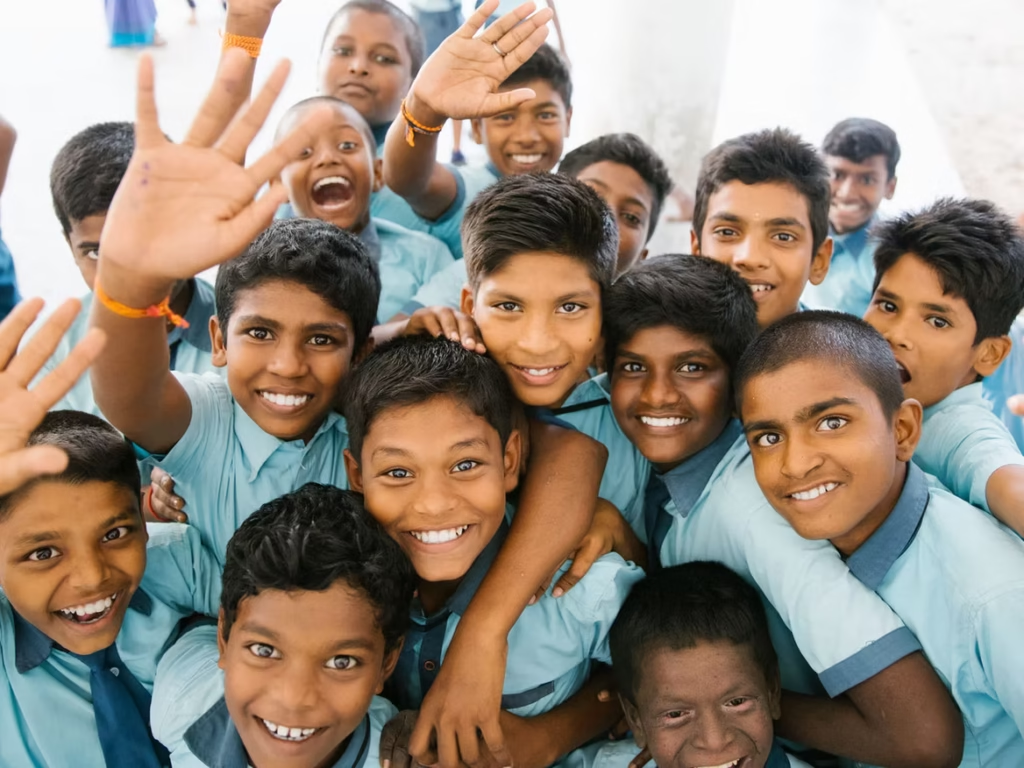
Uttarakhand – Picture green hills, snow-capped mountains, foggy roads, little cottage houses, and clean air – that’s what beautiful Uttarakhand is all about. Uttarakhand or the ‘Land of Gods’ is a state situated in the north part of India with 13 districts, sharing borders with both Nepal and China. The state is known for its extensive and scenic beauty, history, yogic and ayurvedic practices, and soaring surrounding mountains. It is one of the most popular destinations for both Indians and foreigners alike due to the always-present stunning beauty that just changes and shifts, and never disappears. Foggy, green landscape of Uttarakhand About Uttarakhand Within the state, there are many cities and spots most visited by travelers. This includes Dehradun, Kausani, Dehradun, Haridwar, and Nainital, some of the more popular cities with more population than the smaller communities spread out in the valley. We should also not forget Rishikesh, a city made by the popular band The Beatles’ 1968 visit and consequent stay, known for its scenic beauty and the many adventures it offers to travelers. Uttarakhand is also known for being the entry point of the Ganga or Ganges River, where all the tributaries join to make one of the largest widths of the river in India. Uttarakhand is popular for having various different opportunities for volunteering. Volunteering in India itself is something made easy by many NGOs, schools, communities, hospitals, etc. in the country, and many travelers opt for this while exploring India. Travelers are often plagued with the question of low-cost travel in India, and often volunteering is the way to not only explore the country but also help in the process. Why should you volunteer in Uttarakhand? Be a volunteer in the Himalayas!! Volunteering in Uttarakhand Widely categorized, some of the ways you can volunteer in Uttarakhand are (explained further in detail below ) : 1. Volunteering for Women and Community Empowerment 2. Volunteering in Rural Areas 3. Volunteering in Ashrams 4. Volunteering Through Teaching 5. Volunteering through Yoga and Wellness Activities 6. Volunteering as a Health Worker 7. Volunteering for Environmental and Sustainable Development purposes You can find crowded schools in Rishikesh or isolated rural tribes in the mountains of the state, large yogic ashrams, or small farming-driven communities widely across the state to volunteer in. It is important to note that all these options differ in their volunteering process. Some will provide housing and food in exchange for dedicated volunteering, while others will expect volunteers to find their own housing, although will guide them in the process, due to less area and funds. There are some NGOs and communities with strict guidelines and processes for selecting volunteers, and other villages yet may not have even experienced the joy of selfless giving that is volunteering and may welcome visitors with open arms. 1. Volunteering for Women and Community Empowerment The joy of sharing: women showing volunteers local handicraft Women’s education, development, and empowerment, broadly speaking Women empowerment are lacking in Indian society and most communities. In order for the country to grow, prosper, and respect each citizen, this is an undertaking needed to bring about equality between the sexes and ensure independence among women. Many organizations and independent villages/towns have specific volunteering programs focused on the development of communities, in particular the empowerment of women and girls. In these programs, volunteers usually focus on developing basic skills among the women of the community so that they may earn and support their families. Sometimes specific skills such as coding and writing are taught; other times general education and the betterment of the societies are focused on. Either way, the goal of the volunteer is to help out communities where female education is severely lacking and there is a need for the development and empowerment of girls and women. These programs may also focus on pre-teen and teen girls who are educated and empowered so that they are more educated, independent, skilled, and therefore successful. If volunteers are interested in this specific area of volunteering, there are many small villages and communities in Uttarakhand such as Chopta, Kalsi, Mana, etc. where women and schools can be approached for volunteering opportunities with girls and women. Although this is not a full-proof approach, it can be tried out. An easier way would be to find NGOs and organizations that have running programs on community and women’s development such as Ankur, an organization focused on this. 2. Volunteering in Rural Areas Smiling women working in a rural setting Rural villages and areas in India are often plagued with problems concerning even the most basic necessities. Uttarakhand is no different – the state is filled with independently running, mostly self-sufficient communities, often isolated from one another amongst the mountains. The same set of problems is present in all – lack of electricity, education, hygiene, ease of living, etc. There are many small projects volunteers can take up to improve the way of living in these places – for example, better-invented toilet systems, solving basic problems, teaching, helping with construction and odd jobs, etc. There is an immense opportunity for development in these places – and in the end, volunteers can feel satisfied they helped better a community. There is always scope to approach villages and areas where such tasks are always appreciated and there is no lack of hospitality. If you prefer organizations, there are many that allow for homestay and local food during the time you work as well as ample time to explore places nearby. There is a popular project in Kanda, Uttarakhand, the Rural Organisation for Social Elevation (ROSE) that interested volunteers can research and consider. Also, there are Government volunteer programs of which you can be a part. 3. Volunteering in Ashrams Ashram volunteers serving food to locals Ashrams are institutions made for the specific purpose of studying
A Road Scarcely Taken
So, why do we travel? Or better yet, what does it connote? Oh wait, you’re asking me? Well then, come along and let’s (try to?) find out. I walk in rubbery boots, armed against the pouring, unrelenting rain. Why? Because I feel like it? I’m not quite sure, this is all a bit trippy to me, but get used to it. Marching, jogging, skipping. I feel like a kid again, right before I got told off for the umpteenth time for playing around in the muck. But was it muck? It all seemed like fun to me. What’s a little fun in front of everything else? Waaaiiittt……I think I had groceries to buy… When did wondering around in the rain stop? Okay, I got them, so back to what I was saying before……oh great now it’s snowing. Maybe its because I’ve never seen real snow before. Isn’t it supposed to be all glittery and pretty? Well, crunch crunch goes these lazy boots. There’s this cat walking along with me, but is it really a cat? It looks a bit doggish too. I SEE WHAT IT IS! It’s a shapeshifting cat! Not as cool as a time-traveling one, but whatever this one works too. It’s cute, what’s not to like? I suppose you’ve noticed I’m not much of a narrator. This is because I’m trying a thing out here okay? Moving on, it has dawned on me that I can convince this cat to grow wings to fly up this super high peak I see right in front of me. I am a bit afraid of the blue mist I see floating around though. So maybe I should acquire a bribe….. Oh hey good morning. I admit I might have fallen asleep so things have changed. Anyway, getting back on track it turns out the cat took me up anyway. Strangely sweet of it. It also took away my imaginary supplies. There is this boat here I probably need to steer around though. So, I guess I’ll try that and let you know what happens. Ending up on a boat? Never imagined that. I see this picturesque meadow with grass that looks like it’s made of Swarovski. Maybe I’m mixing up things here. But it adds to the aesthetic, hence it shall remain. An owl perches on my shoulder and gives me a comforting screech. So, I set off on this epic sounding journey, along the lilac brick road. I wonder where my friends are. They probably did the sensible thing and said goodbye before this journey got too jumbled. Maybe this is a self-discovery kind of trip after all. Therefore, you should know I was very surprised when the owl flew down and jumped to the ground a sleek cat. Right, should’ve figured. But its nice to not be completely alone. Though I wouldn’t mind that either. Jog Jog Jog. Exercising like I haven’t in years. The cat gives me a scornful glance. I don’t mind it. I walk by piles of pebbles all made of this glowing indigo stuff. Perhaps it’s a sign for what is to come next. Splash I go into a pond of water I hardly anticipated. Just my luck. Here I was hoping for something so mind-blowing I could run back to my friends and boast about. Oh well, guess I’m skipping this part for that conversation. Speaking of which, why exactly do I care so much about them? It isn’t like I recall what they look like. Maybe it was all about boasting after all I suppose you must have realized much before me that time possibly runs differently here. Time is such a strange thing. It helps you measure the span you have left to live. Not like that matters here. Clearly, I am far beyond it. I have been walking an eternity on this road but haven’t the slightest idea why. Nothing even surprises me anymore. But I’m not really sad about it. Perhaps I’m actually starting to learn more about myself. The feline approves of this thought. There is no road anymore. Just what I reckon you would recognize as sand. Sand that is as smooth as water. I walk my way. It has been so very long since I’ve encountered someone who speaks. So much so that I believe it completely acceptable that it happens to be a unicorn. A mythical creature? Not quite so anymore. It smiles. That’s a bit creepy. “Welcome,” it says. “Have you found out what you are? Have you ‘found’ yourself? It has been what you were searching for, is it not?” In response to this philosophical inquiry, I croaked hoarsely, “Eh?” In hindsight, I suppose it makes sense. I, like many other clueless human beings, feel trapped, misunderstood, dependent. Maybe that’s why I left home. I left everyone behind. I wonder if I thought it was selfish of me back then. But my memory hasn’t been the greatest to begin with. Once again, I’m trying to piece together a puzzle whose answer evades me each time. Who am I?? You only know me as ‘I’, after all. But you don’t really know me either. Here we go again. Maybe that’s where travel helps. It helps you discover who you are. The kind of person you are, when you are finally untethered. To visit the places you’ve never been, both outside the barriers of your home, and in the expanses of your mind. In a book. Via a train. On the back of a unicorn, with an agitated cat hanging onto your cloak for dear life. You get to define what travel is for you. On your own terms.
Urban Legends: Satanic Sacrifices

Mr. A was over the moon! Obviously not literally, but after many unsuccessful relationships, things finally set the chord after he met Zara. She was the prettiest girl he had ever seen. Her apple green eyes reminded him of the forbidden fruit planted in the Gardens of Eden. Her chocolate brown hair, falling messily on her tanned face, made her look like Aphrodite, the goddess of love. The dark brown freckles, around her face, gave her that exotic look Mr. A was longing to see his whole life. It had only been 2 weeks since they had started dating, but Mr. A was already in love. By: www.pexels.com This is what he used to do with every other woman he met. Spontaneity was kind of his thing, but he often confused it with stupidity. He broke up with his now ex-girlfriend for someone he met over coffee. Love, for him, was like the noisy and fierce, but fleeting froth of an instant coffee. Sure, you do like it, but the ‘instant’ gratification is after all temporary. But it wasn’t just her looks that left Mr. A spell-bounded, it was the fact that she was like him in many ways and unlike him in other ways. Sure, the animal magnetism also played its part, but it was her personality that left him speechless. She was relentless, steadfast and tenacious. She was serious about a lot of things but goofed around a lot. With her, Mr. A wasn’t just happy but felt joyous. The first time in his life, he felt that this was something real. Something worth holding onto. Little did he know that Lucifer plays with his puppet by giving him the freedom to reach where he was wanted in the first place. By: www.inc.com It was a Sunday and Mr. A was supposed to meet Zara for coffee. She was ten minutes late, but that didn’t bother him, she was always late. He thought he might as well order coffee to pass the time. He went over to the barista and ordered whipped coffee with almond milk, her favorite and an espresso. He wasn’t even finished when he felt a tap on his shoulder. He turned, and he found Zara, in a white shirt and denim shorts, smiling at him. He realized something at that moment, that this smile was worth millions. They both sat at their table and began sipping and suddenly Zara, out of no-where, blurted out. “Let us go on a trip!” “What? Why?” responded Mr. A “Why not?” asked Zara. “Well, for one thing, I have a job!” “Didn’t you tell me that you have a lot of vacation days left?” Asked Zara in a dismissive yet endearing tone. “Yes, but I’ve saved them for emergencies or in the rare case I go to Vegas!” replied Mr. A cockily. “C’mon! We will have so much fun. You don’t even have to pack! I’ll do all the packing! I just want to travel with you!” “Where will we even go?” asked Mr. A weakly after realizing that this was a lost battle. “I have just the place!” After a day of packing, Mr. A and Zara were ready. Mr. A was surprised that how did she manage to book all the tickets so quickly to which she replied that she used The Tarzan Way app. Although suspicious at first, he came to ease after she swore that all the travelers use this app. They were supposed to board the bus to the destination, still unknown to Mr. A, on the evening of Tuesday. It was a sixteen-hour long journey. Mr. A thought that now he had a real opportunity to know the person he likes so much. He wanted to know everything about Zara, who for some reason never opened up about her past in particular. She also used to go suspiciously silent when asked about her family or friends. The only thing she would talk about was all the places she had visited and all the guys she had dated. This also made Mr. A jealous, but he convinced himself that Zara was genuinely interested in him as was apparent by the trip she had planned for them. During the bus ride, they got into talking and all was going well. They were talking about all the things they would do once they reached there. The conversation was sparkling until Mr. A asked “Where are we going, babe?” “What do you mean babe?” “Umm, nothing I just thought….” “What did you think? That I am your babe!?” “I didn’t mean to offend you.” “Well you just did, right?” “I am sorry.” Mr. A’s heart just sank. He couldn’t believe what just happened. Although he knew this wasn’t a big deal he felt uneasy. He just didn’t understand what happened. Not only what, but why did it happen. He felt this sudden urge to breathe in the fresh air. It was what he would do anytime he couldn’t think. He opened his window and gazed outwards. He could see that the bus was riding on a mountain, and the best-educated guess he could make was that they were going to the Himachal. Where? That was still a mystery to him. As he looked outside, he saw majestic snow-capped mountains standing proudly at a distance. Near to him were smaller hills covered with lush green and dense forests. He could hear the gushing sound of the water, suggesting a river nearby hidden by the canopy cover of the forest. By: www.journeytoexplore.com He thought that this picturesque location was worthy of being captured by the photographic technology also known as the camera. After he clicked a dozen of pictures, he looked at Zara, who was fast asleep. Looking at her face, he felt that she was looking adorable beyond imagination, so, he took a picture of her too. As time passed by, Mr. A dozed off to sleep with the help of the gentle rocking of the
The Contemporary Traveler!

If you are at all present in the world and see cheesy movies then you must know that traveling is all the rage now. Young people want to work hard not to settle but travel the whole world. With the ever-improving technology and an exponentially increasing access to it this, once a herculean task, has now become a relatively smaller one. Photo by Charlotte Noelle on Unsplash But what is it that attracts the Gen-Y and the Gen-Z people to travel? Is it the cheap airline tickets or the affordable railways fare? Is it just an overly spread out viral challenge? What is it that traveling does? If at all it does anything. After traveling to more than a dozen places, ranging from beaches to mountains and deserts to forests myself, I’ve developed strong opinions on this issue. I do not claim that the reasons I am about to give you are right, but I know that they make sense to me, and are true to my very best knowledge. I think that the current scenario is so not just because of several individual factors but a long list of reasons intertwined in a very complex web structure. I also want to be clear on the fact that I will be as elaborate and clear as possible to explain properly what I am trying to convey. Photo by Priscilla Du Preez on Unsplash Starting from the first question which pertains to the appeal traveling has for the younger generation, the answer is very clear. We are at the meeting point of technological revolution, globalization, and the culture of risk-taking. Individuals have developed this curiosity which has effectively changed the culture of settling down to the tradition of trying and testing out things before. The younger generation is not interested in the old ways but wants to try out new things. The individuals want to witness different cultures, traditions, cuisines. They feel that they are part of something much bigger than their national identity. They feel that they are truly a part of this greater society and not experiencing each integrant of this beautiful and magnificent global village is inherently sinful. The elaborate interconnectedness which allows a person to reach from one place to another in just a matter of days is also a compelling reason. Adding on to this are the massive drops of the prices of airline tickets, and railway fares across the world. Traveling or vacationing is not just a rich man’s dream, but well within the grasp of the middle class as well. But, in all this reasoning we have forgotten about the most important element. The growth of an individual’s personality, the change in his character, his perception after traveling is not only apparent but can-do wonders for him. Photo by Taras Zaluzhnyi on Unsplash The first thing that comes to mind is that it increases happiness, boosts confidence and morale, and improves self-satisfaction. It provides you with an outlet to bust out your stress in a productive manner. Traveling to a foreign country also exposes you to different cultures and norms which also helps you to rewire your brain, making you more perceptive and provides a much-needed change from your mundane and monotonous lifestyle. In the expressive words of writer Patrick Rothfuss: A long stretch of road can teach you more about yourself than a hundred years of quiet. Photo by Anastasia Petrova on Unsplash Traveling to someplace new and unknown can simultaneously make you feel intimidated and excited which in turn helps by making an individual more adaptable to a difficult situation and teaches them how to deal with them. This imparts the ability, to a person, to mentally and emotionally deal with tough situations. It makes them more flexible in difficult situations and also allows them to operate far beyond their comfort zone. Traveling to different places also stimulates creativity. Interacting with the local culture allows you to subsume different and previously unknown stimulants that increase the depth of your thought and productivity. Traveling also can make you realize what is important in your life. It helps you figure out what you want rather than let you continue to do what is expected of you. It teaches you how to make decisions and then prepares you to face the consequences of your actions. Traveling is also responsible to help you find yourself; this sui generis personality dancing to the rhythm of his soul in a sea of banality. It helps you realize that you are unique and your thoughts matter, your ambitions matter and that you play an important role in this grand and carefully woven tapestry, known as the universe. Last but not the least, there is also no denying the fact that traveling makes you more interesting and sexier. With several funny, adventurous and life-altering tales to tell, it automatically puts you on top of the dating pyramid. It will make you look young, radiant and carefree. Traveling with your partner also helps to strengthen your relationship as the much-needed carefree time is hard to get, and if you are a solo traveler then it provides you with ample opportunities to take selfies at picturesque locations. Photo by Taras Zaluzhnyi on Unsplash So, in the end, I hope that I have answered most of the questions related to the culture of traveling and the reason for its boom. I hope that what I said was sound and made sense. If it did not, do not worry, more is yet to come. Also, I would just like to say that even though I have listed several reasons supporting the fact that traveling is good for an individual there might be some people who wouldn’t believe me or choose to experience this on their own, to them I say “Be an open-minded person and then make your decision. A decision that will change your life. Go ahead! See the world, Explore different cities, experience different cultures. Trek in the
8 Virtual Tours to feed your Travel Bug when Stuck at Home

India has a wealth of heritage sites and iconic historical monuments, now the whole world can view these World Heritage Sites, without even having to go there, Simply Awesome. Here’s a list of 8 monuments that provide a virtual walkthrough of it. 1. Vittala Temple By: Flickr The Vittala Temple in Hampi is the highlight of the beautiful town. The ancient monument is well-known for its extraordinary architecture and craftsmanship. Vittala, after whom the temple is known, is a form of Lord Vishnu. This aspect of Vishnu was worshiped in this part of the country as their cult deity by the cattle herds. The Vittala temple complex is a sprawling area surrounded by high walls and three towering gateways. This temple has some beautiful stone structures – like the stone chariot which cannot be described in words and the interesting musical pillars. The temple is a major draw amongst the tourists who come from across the globe to witness the once-glorious Vijayanagara capital, which lies in ruins now. 2. Bhimbetka-Rock Shelters By: https://www.timetravelturtle.com/bhimbetka-rock-shelters-india/ The Rock Shelters of Bhimbetka are in the foothills of the Vindhyan Mountains on the southern edge of the central Indian plateau. Within massive sandstone outcrops, above the comparatively dense forest, are five clusters of natural rock shelters, displaying paintings that appear to date from the Mesolithic Period right through to the historical period. The cultural traditions of the inhabitants of the twenty-one villages adjacent to the site bear a strong resemblance to those represented in the rock paintings. 3. Badami Cave Temple By: https://bagalkot.nic.in/en/tourist-place/badami-caves/ Badami or The home of cave temples is located in a valley of rugged red sandstone, surrounding the Agastya Lake. It is an archaeological delight owing to its beautifully crafted sandstone cave temples, fortresses, and carvings. Once the royal capital of the Chalukyas, Badami continues to enjoy a unique place, being the home to a number of examples of Dravidian architecture which sustains and enhances instances of both south and north Indian style of architecture. There are three Hindu Temples and one Jain Temple in Badami Caves. 4. Humayun’s Tomb By: Unsplash Humayun’s tomb is sublimely well proportioned, seeming to float above its symmetrical gardens. It’s thought to have inspired the Taj Mahal, which it predates by 60 years. It is known to be the first garden-tomb in the Indian subcontinent. The design of Humayun’s tomb is a typical Mughal architecture with Persian influences. The mausoleum itself stands on a high, wide terraced platform with two bay deep vaulted cells on all four sides. Humayun’s garden-tomb is also called the ‘dormitory of the Mughals’ as in the cells are buried over 150 Mughal family members. 5. Mahabalipuram By: Unsplash Mahabalipuram is an antiquated port city in the Kancheepuram area of Tamil Nadu, close to Chennai, where a clamoring seaport and a bustling city co-exist. Famous for its intricately carved temples and rock-cut caves. Once the abode of the famous demon king Mahabali, Mahabalipuram was later renamed Mamallapuram. The serenity, the alluring atmosphere and the impressive setting with many beautiful white sandy beaches dotted with casuarina trees are all reasons as to why one would want to visit this wonderful town. Today it is an ideal destination for rejuvenation and idyllic setting. 6. Victoria Memorial By: Unsplash The Victoria Memorial, a huge monument made of white marble located in the heart of the City of Joy, Kolkata in West Bengal. It stands upright in all its glory and grandeur, by the banks of the mighty Hoogly river. Dedicated to Queen Victoria, this architectural marvel is truly a poem in marble. The myriad of statues in the sprawling garden also reflects the finesse and skills of the craftsmen and impels us to rightly call it another charming Taj. 7. Taj Mahal By: Unsplash It was built by the Mughal Emperor Shah Jahan as a memorial for his third wife, Mumtaz Mahal. Constructed entirely out of white marble in the 17th century, it is among the finest edifices of Mughal architecture. Rabindranath Tagore described it as “a teardrop in the cheek of eternity“ Standing majestically on the banks of River Yamuna, the Taj Mahal is synonymous with love and romance. The Taj has as many shades as any kind of beauty can ever have! The Taj is pinkish in the morning, milky white in the evening, golden when the moon shines and the intermediary variants during different hours of the day and during different seasons in a year. The grace of perfection of proportions and grandeur of geometrical patterns of well appointed gardens enhancing the poise of the whole complex together add magnificence to the delicacy of this mance of love, dedication, and purity. 8. Qutub Minar By: Unsplash Standing tall and proud as the insignia of the Mughal might and dominion, Qutub Minar is an iconic monument that spells out the narrative of Delhi like no other. In red and buff sandstone it is the highest tower in India and is the world’s tallest brick tower. This is a tower of victory, a monument that signifies the might of Islam, or a tower for keeping a check for defense. Qutab Minar is a soaring, 73 m-high tower of victory and has five distinct storeys. A 7 m-high iron pillar stands in the courtyard of the Minar. It is said that if you can encircle it with your hands while standing with your back to it your wish will be fulfilled.